
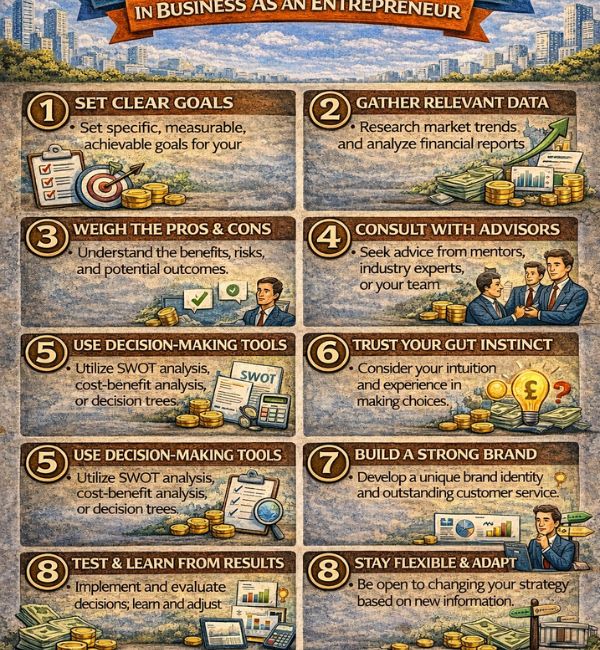
Entrepreneurs have to make decisions day by day. “Entrepreneurs make some decisions about minor operational issues and others that influence the future of the business.”Skill to make wise choices is usually what distinguishes thriving entrepreneurs and poorly performing business owners.
Making decisions requires one to think well, have trusted information and have a good leader. Companies that have entrepreneurs who nurture good decision making capacity are able to resolve issues within a short duration and lead their businesses to greater heights.
This is a guide on practical strategies which can assist the entrepreneur to make better decisions in business.
Define the Problem Clearly
It is always good to start every decision by having knowledge about the problem. Entrepreneurs occasionally jump into the solution without evaluating the actual problem.
The solution should be picked when the root cause of the problem is established by the business owners. Posed questions can aid in understanding of the situation. For example:
is the challenges of the business?
What was the cause of this problem?
What is the impact of this problem in the busines?
Problem definition also assists entrepreneurs in working on the appropriate solution.
Best Financing sources to start a business in the UK
Collect the Relevant Information
Entrepreneurs ought to gather credible data prior to making critical decisions. Proper data enables the business owners to weigh options better.
This information can be provided by a number of sources, such as
financial reports
customer feedback
market research
employee insights
Owners of businesses who make decisions based on data are likely to make an informed decision.
Evaluate Different Options
Entrepreneurs can hardly have a single solution. There is a tendency to have multiple choices available and all choices have various advantages and risks.
The owners of businesses are to compare offered options and consider possible results. When weighed against the merits and the demerits, this will assist business people to find the most efficient solution.
The evaluation can carefully decrease uncertainty and enhance the level of the decision.
Take into Account Risks and Consequences
Any business decision is associated with a certain amount of risk. Businesspeople have to consider potential outcomes before acting.
Risk assessment assists business owners to have a feel of what may be in store and how to solve. To use an example, the introduction of a new product can take both monetary investment and marketing.
Entrepreneurs need to evaluate the risks of the ventures against the benefits.
Seek Advice from Experts
Entrepreneurs do not have to make all decisions by themselves. Seasoned advisors, mentors and industry experts can be of good advice.
Accountants, lawyers or business consultants are some of the professionals who can help business owners. These professionals provide expertise knowledge that enhances the quality of decisions.
Teamwork also brings in different angles that the entrepreneurs might not have taken into consideration.
Use Data and Analytics
In the contemporary business environment, it is important that decisions are based on data. Analytics tools assist the entrepreneur in analyzing customer behavior, marketing performance and financial trends.
“Website analytics show which marketing strategies attract the most customers. Sales data helps businesses identify popular products and profitable market segments.”
Evidence-based decisions can be made by entrepreneurs through data analysis, as opposed to guesses.
This is to avoid Emotional Decision-Making
Entrepreneurs are usually enthusiastic of their businesses. Nevertheless, emotional responses at times result in poor decision-making.
Those who own businesses must be objective and calm in the process of making their decisions. Logical thinking assists an entrepreneur to evaluate facts and use the strategies that are most effective.
Emotional discipline enhances the accuracy in deciding
Set Clear Business Goals
Effective decisions are made in accordance with clear goals. Entrepreneurs that have long-term goals can determine whether a decision is in line with their vision.
As an illustration, a company that intends to go global can value strategies that make it more visible across the globe. Goals assist the entrepreneur to match the decisions with the long-term growth plans.
Goals are kept in mind and this makes decision-making to be more strategic.
Pilot Test Before Total Implementation
Businessmen tend to enjoy experimentation without using significant resources. Minor tests are used to determine the ability of a strategy to succeed.
As an illustration, a firm can pilot a marketing program among a small group of people and then roll it out to the entire country. The prototypes of the products also assist in gathering customer feedback prior to their full production.
Testing minimizes risk and enhances better decision making
Learn from Past Decisions
“Every business decision creates a learning opportunity. Entrepreneurs should review past decisions and evaluate their results.”
“Success reveals strategies that work, while failure provides lessons that improve future decisions.”
Constant learning enhances the level of leadership and assists entrepreneurs to make better decisions as time goes by.
Conclusion
Good decision-making is among the most significant entrepreneurial skills. A smart business owner is the one who formulates issues, finds sound, information, analyzes risk, and applies evidence-based decisions.
Objective entrepreneurs that learn through experience enhance their leadership skills and steer their companies to success. Good decision making processes enable the entrepreneur to navigate through the difficulties in business boldly and establish long lasting businesses.