
It may take a lot of finances to start and expand a business. A large number of entrepreneurs in the United Kingdom seek quality sources of funds to initiate new ideas or to grow the already existing firms. Access to capital enables business to invest in equipments, advertising, employee recruitment and development of products.
Luckily, there are a number of sources of funds that assist business owners in the UK. Government programs, private investors, bank loans and other finance solutions can be explored by the entrepreneurs. Both options have various benefits based on the requirements and the business maturity.
This guide is a guide that expounds on the most significant funding avenues open to small businesses in UK.
Best Financing sources to start a business in the UK
Government Start Up Loans
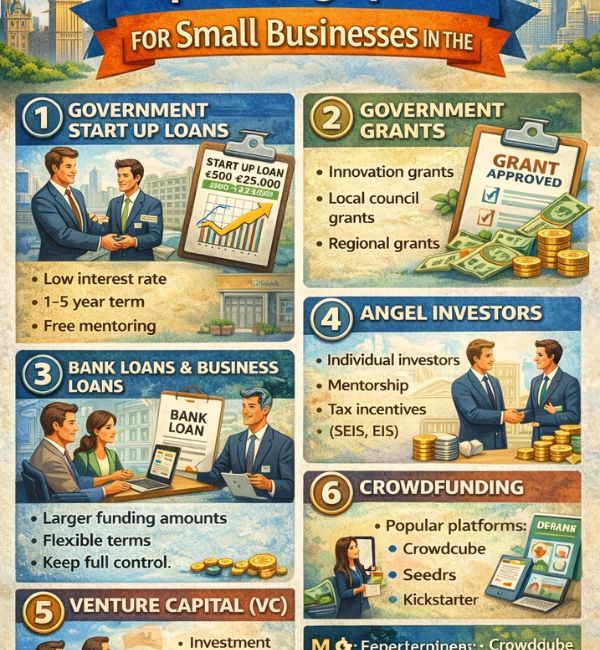
The Start Up Loans are a popular funding program offered by the UK government. This is a program to assist those entrepreneurs wishing to start or expand a new business. It offers low cost financing and mentorship.
Through the program, entrepreneurs are able to borrow between PS500 and PS25,000. “The loan has a fixed interest rate and flexible repayment terms. Many founders choose this option because it offers a simple application process and valuable business advice.”
New companies tend to utilize this money as they buy equipment, create websites, initiate marketing campaigns, or pay their initial operation fees.
Small Business Grants
Grants are financial assistance that the companies do not have to repay.“Many government bodies, local councils, and institutions offer grants to promote innovation and economic development.”
Sometimes small business grants are targeted at particular industries, including technology, green energy, manufacturing or research. The entrepreneurs have to be eligible and present elaborate plans as to how they intend to utilize the funds.
Despite the intense competition on grants, the winning business people get good grants that will grow the business without generating debt.
Bank Business Loans
Conventional bank loans still remain a typical source of funds that are raised to finance small businesses. The banking system of major providers of the UK like Barclays, HSBC, Lloyds, and NatWest provide loans targeted at entrepreneurs and developing companies.
There are various factors that banks normally consider prior to granting a loan. These are such factors as credit history, business plans, financial projections and repayment ability.
Bank loans are frequently used to finance the expansion initiative, buy inventory, or invest in new equipment by the business owners. Sound financial planning raises the possibility of getting loans.
Angel Investors
Angel investors offer funds to start-ups at the cost of equity. Such investors tend to involve highly experienced business persons or very rich people who fund viable business ideas.
Angel investors do not necessarily just provide financial support. Several investors contribute to sharing of industry expertise, strategic direction as well as professional networks that are important.
Angel investors show the greatest interest in startups that seem to have good growth potential and are innovative. Entrepreneurs tend to pitch their ideas in form of a pitch presentation or networking.
Venture Capital Funding
VCs put money in startups that have a high growth perspective. These are investors who normally target technology firms, innovative products or scalable businesses.
The amount of venture capital investments is high as opposed to other sources of funds. They do not however, want to be deprived of equity ownership and good business growth.
To get access to venture capital funds, entrepreneurs are required to outline their business plans in detail, and show evident prospects in the market.
Crowdfunding Platforms
Crowdfunding enables business people to raise funds through a huge number of followers. Thanks to the Internet, campaigns like Kickstarter and Crowdcube have been used to raise awareness of the startups among those who wish to financially contribute to good ideas.
Business proprietors develop advertising that justifies their product, vision and monetary objectives. The money that supporters will provide will be small amounts that will help the project to achieve its success.
Crowdfunding is also used to ensure that businesses sound their ideas and raise early communities. Effective campaigns usually create publicity and create market interest.
Business Credit and Overdraft Facilities
Banks also tend to offer credit lines or overdraft which are useful to business to cover temporary financial obligations. These alternatives enable business entities to have access to other funds in the situation when cash flow is constrained.
Business credit is effective in covering the business operating costs like payment to suppliers, purchase of inventory or short term financial deficit.
Proper utilization of business credit contributes to the continuation of smooth business and facilitates the day-to-day running of business.
Growth Guarantee Scheme by Government
UK government came up with the Growth Guarantee Scheme, which assists the small businesses in accessing financing. This initiative will give lenders incentives to lend to businesses that may have a hard time accessing conventional financing.
The plan is in favor of loans, overdraft, and asset finance facilities. It assists companies to invest in growth projects and long term investment.
With this program, business persons are able to get funding easily and with clear business potential.
Family and friends Investment
“Friends and relatives also support many entrepreneurs who start their businesses. Personal networks often provide startup funding when other sources are difficult to access.”
Proprietors of businesses should take these investments seriously. Developed claims and redeeming schemes are useful to ensure good individual relationships.
Even though this alternative involves trust and transparency, it can be a flexible source of early-stage start-up financing.
Select the Right Funding Alternative
Each business has its own financial requirements and objectives of expansion. Entrepreneurs are expected to consider all the needs of funding options prior to decision making.
There are other businesses that use loans due to the fact that founders can retain complete ownership. Others select investors who can give funding as well as strategic guidance.
The right business plan and economic forecasts work better in ensuring that the entrepreneurs can find funding easily.
Conclusion
Funding opportunities are numerous to the small businesses in the UK. Entrepreneurs receive great assistance in the form of government loans, grants, bank financing, investors, and crowdfunding platforms.
When owners of businesses are aware of these options, they can select the funding strategy that fits their purposes. “Through proper financial planning and strong business strategies, entrepreneurs can secure the capital needed to expand successful businesses.”