
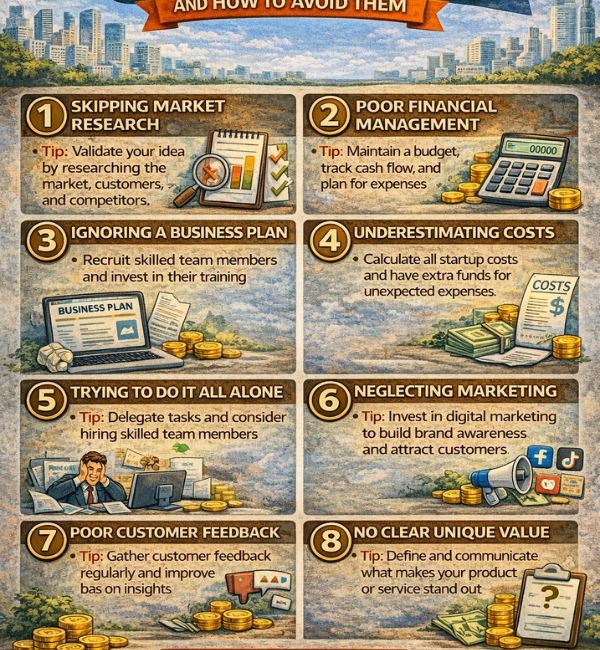
Business startups are exciting opportunities, yet most of them have challenges in the initial phases. Entrepreneurs are also inclined to innovation and growth but pay insufficient attention to the business fundamentals. Any errors done early on may cause delays or even cause the business to close down.
These are the mistakes that successful entrepreneurs consider and implement wiser strategies. Through the knowledge of typical startup pitfalls, entrepreneurs in business will make their decisions more efficiently and have more chances of long-term success.
This guide outlines some of the typical start-up pitfalls and is practical in giving the advice on how to prevent them.
Top Online Marketing Strategies for Small Businesses
Beginning with Inadequate Preliminary Market Research
There are a lot of entrepreneurs who have started business without researching the market, by relying on their own ideas. Success cannot be achieved on the basis of a great idea alone. Companies need to address actual issues that a client goes through.
“Entrepreneurs must research their target audience before launching a product or service. They should study customer needs, buying patterns, and market trends. Market research also helps them identify competitor strategies and potential opportunities.”
This is due to a clear vision of the market enabling entrepreneurs to formulate solutions that will appeal to the customers.
Ignoring Business Planning
Other business people lack the time to make a proper plan and therefore they dive into starting a business. The absence of business plan makes the entrepreneurs to find it difficult to set targets, control resources, and evaluate the progress.
“A business plan clearly presents the company’s mission, target market, marketing strategy, and financial estimates. It also helps entrepreneurs anticipate challenges and develop solutions.”
Planning does not remove risks, it only assists entrepreneurs to make sound decisions and focus on long term goals.
Poor Financial Management
One of the most prevalent reasons behind start up failures is financial mistakes. The entrepreneurs often end up spending excessively in the initial phases of expansion or neglect cost monitoring.
Efficient startups have good fiscal discipline. The entrepreneurs need to keep a check on the cash flow, keep track of the operation cost, and prepare feasible budgets.
Proper financial control will make sure that enterprises will have sufficient resources to respond to the operations and expansion programs.
Attempting to Do It All on Your Own
Most entrepreneurs will set out to do everything by themselves. As much as commitment and effort are valued, it is difficult to run all the duties single-handedly which can restrict the growth of the business.
Start ups have good teams and professional backing. The entrepreneurs are advised to work with skilled staffs, consultants and other partners who possess expertise useful in the business.
Sharing duties permits the founders to be engaged in strategic leadership and business.
Weak Marketing Strategy
Without proper marketing, an excellent product or service is not possible. Other startups have a high level of investment in product development and do not focus on marketing.
The business owners need to devise effective marketing campaigns that will assist them in accessing their target market. Digital communication tools like social media, content marketing and search engine optimization assist business entities to create a presence.
Regular advertisements get customers and brand recognition.
Ignoring Customer Feedback
The feedbacks left by customers give good information which assists business organizations to make better products and services. Nonetheless, other entrepreneurs disregard feedback and keep working without adopting required changes.
Effective startups pay attention to their clients. Feedback indicates the areas of strengths, weakness, and areas of improvement.
Companies that are responsive to customer demands tend to create better products and create communities of loyal customers.
Expanding Too Quickly
The growth might seem thrilling at a rapid pace, but when it becomes out of control, it may pose a challenge in operations. Other startups are trying to grow too fast without developing well-built systems.
Entrepreneurs ought to consider long term development instead of the high growth rate. Scaling is based on stable operations, satisfied customers, and dependable processes.
Slow growth enables business to be quality conscious and resourceful.
Selecting the Bad Business Partners
Partnerships may be of great assistance to business but ineffective partnerships always cause severe clashes. The entrepreneur must decide on partners well and be certain that all partners have the same vision and goals.
Contractual agreements and responsibilities will avoid confusion. Effective collaborations demand trust, communication and commitment to the business.
Good relationships also help in business sustainability and success in the long run.
Lack of Adaptability
Business environments are dynamic. Busines performance can be influenced by new technologies, changing customers preferences and economic changes.
Business people who are not flexible usually find it hard to keep up with competition. Effective startups keep checking on market trends and change strategies where needed.
Flexibility enables businesses to be fast in responding to new opportunities and challenges.
Losing Track of Long-Term Vision
The present day problems tend to pull an entrepreneur out of focus. The problems of everyday functioning can take time and effort.
Effective entrepreneurs have a vision of what their business is likely to become in the future. The decisions taken are based on long-term goals and not merely on addressing the present issues.
Good leadership and strategy enable startups to stay on track and not to give up.
Conclusion
Any start-up will have difficulties at the initial stages. Nevertheless, by identifying and preventing some of the pitfalls that lead to a business collapse, entrepreneurs are likely to prevent numerous business failures.
Strong financial management, effective marketing, market research and customer oriented strategies are the much needed cornerstones to success. Businesspeople who make learning mistakes and keep on bettering their strategies develop better businesses.
“By staying focused, flexible, and disciplined, entrepreneurs can overcome challenges and build successful companies that grow over time.”